The Precious Pearl in the Rulings of Dress and Adornment
1. Al-Qaza‘ (Partial Head Shaving)
https://t.me/Menzbenefits/173
2. Hair Extension (Attaching Hair)
https://t.me/Menzbenefits/174
3. Combing and Styling the Hair
https://t.me/Menzbenefits/175
4. The Virtue of Gray Hair and the Ruling on Changing It Without Using Black
https://t.me/Menzbenefits/176
5. Covering the Head and Not Uncovering It
https://t.me/Menzbenefits/177
6. Letting the Beard…
The Precious Pearl concerning the rulings of clothing and adornment
32: Prohibition of wearing clothes for show
The Messenger of Allāh ﷺ said:
“Whoever wears a garment for show in this world, Allāh will clothe him with a garment of humiliation on the Day of Resurrection, and will set it ablaze with fire.”
[Reported by Abū Dāwūd (4029)]
Explanation: What is meant by garment for show is clothing intended to be noticed by people, whether it is a fine garment worn for worldly pride…
The Precious Pearl concerning the rulings of clothing and adornment
31: Wearing white garments
The Messenger of Allāh ﷺ said:
“Wear white garments, for they are among the best of your garments, and shroud your dead in them.”
[Reported by Abū Dāwūd (3878)]
The Precious Pearl concerning the rulings of clothing and adornment
30: What to supplicate when wearing a new garment
It is narrated from Abū Saʿīd Al-Khudrī that the Messenger of Allāh ﷺ, when he acquired a new garment—whether a shirt or a turban—would say:
“O Allāh, all praise is for You. You have clothed me with it. I ask You for its goodness and the goodness for which it was made, and I seek refuge in You from its evil and the evil for which it was made.”
And the Prophet ﷺ…
The Precious Pearl concerning the rulings of clothing and adornment
29: Starting with the right side (Tayāmun) when wearing clothes
It is narrated from ʿĀʾishah that she said:
The Prophet ﷺ liked starting with the right in putting on his sandals, in washing his feet, in purification, and in all of his affairs.
[Reported by Al-Bukhārī (167) and Muslim (268)]
And the Prophet ﷺ said:
“When you dress and when you perform wudu, start with your right side.”
[Ṣaḥīḥ Abī Dāwūd (4141)]
The Precious Pearl concerning the rulings of clothing and adornment
28: Wearing transparent and tight clothing
The Messenger of Allāh ﷺ said:
“There are two types among the people of the Fire whom I have not seen: a people with whips like the tails of oxen with which they beat people, and women who are clothed yet naked, swaying and inclined, with their heads like humps of tilted camels. They will not enter Paradise, nor will they smell its fragrance, though its fragrance is…
The Precious Pearl concerning the rulings of clothing and adornment
27: Wearing pure red
It is narrated from Al-Barāʾ ibn ʿĀzib that he said:
The Prophet ﷺ forbade Al-mayāthir Al-ḥumur.
[Reported by Al-Bukhārī (5838) and Muslim (2066)]
And from ʿAlī ibn Abī Ṭālib that he said:
The Messenger of Allāh ﷺ forbade wearing Al-muʿaṣṣafar.
[Muslim (2078)]
Explanation: Al-Mayāthir is the plural of Maytharah, which refers to soft, fine cloth. Al-Muʿaṣṣafar: dyed with safflower, which…
The Precious Pearl concerning the rulings of clothing and adornment
26: Wrapping oneself completely (Ishtimāl Aṣ-Ṣammāʾ) and sitting with the legs spread (Iḥtibāʾ)
It is narrated from Abū Saʿīd Al-Khudrī that he said:
The Messenger of Allāh ﷺ forbade Ishtimāl Aṣ-Ṣammāʾ, and that a man should sit with his legs spread, while wearing a single garment that leaves nothing covering his private parts.
[Reported by Al-Bukhārī (367)]
Explanation: Ishtimāl Aṣ-Ṣammāʾ: wrapping the body…
The Precious Pearl concerning the rulings of clothing and adornment
25: Garments with pictures (of animate beings)
It is narrated from Ibn ʿAbbās that he said to a man who was making images: I heard the Prophet ﷺ say:
“Whoever makes an image, Allāh will punish him until He breathes life into it, and he will never be able to breathe life into it.”
The man became extremely frightened (i.e., his fear intensified) and his face turned pale.
He [Ibn ’Abbās] said: “Woe to you! If you…
The Precious Pearl concerning the rulings of clothing and adornment
24: Animal skins (from wild beasts)
It is narrated from Abū Al-Malīḥ ibn Usāmah, from his father, that
the Messenger of Allāh ﷺ forbade the use of skins from wild beasts.
[Ṣaḥīḥ Abī Dāwūd (4132)]
He ﷺ said:
“Do not ride on khazz or Nimār.”
[Ṣaḥīḥ Abī Dāwūd (4139)]
Explanation: Khazz: material that contains silk mixed with other fibers. An-Nimār: tiger skins. They are both prohibited because they involve…
The Precious Pearl concerning the rulings of clothing and adornment
23: Silk garments
The Messenger of Allāh ﷺ said:
“Do not wear silk, for whoever wears it in this world will not wear it in the Hereafter.”
[Reported by Muslim (2069)]
And he ﷺ said:
“Gold and silk are permitted for the women of my nation, and forbidden for its men.”
[Ṣaḥīḥ An-Nasāʾī (5148)]
It is permissible to wear it for someone who has a skin ailment or similar condition; as narrated from Anas, who said:
“The…
The Precious Pearl concerning the rulings of clothing and adornment
22: Trailing garments below the ankles (for men)
The Messenger of Allāh ﷺ said:
“Whatever of the lower garment hangs below the ankles is in the Fire.”
[Reported by Al-Bukhārī (5787)]
And he ﷺ said:
“The lower garment is to the middle of the shin, or to the ankles, and there is no goodness in what is below that.”
[Ṣaḥīḥ Al-Jāmiʿ (2769)]
And he ﷺ said:
“Beware of letting the lower garment hang down, for that is…
The Precious Pearl concerning the rulings of clothing and adornment
21: Extravagance in clothing
Allāh the Exalted says:
“O children of Ādam, take your adornment at every mosque, and eat and drink, but do not be extravagant. Indeed, He does not love the extravagant.”
[Al-Aʿrāf: 31]
And Allāh says:
“And those who, when they spend, are neither extravagant nor miserly, but are moderate between that.”
[Al-Furqān: 67]
And the Messenger of Allāh ﷺ said:
“Eat, give charity, and dress,…
The Precious Pearl concerning the rulings of clothing and adornment
20: Humility in dress
The Messenger of Allāh ﷺ said:
“Whoever abandons fine clothing out of humility for Allāh while he is able to wear it, Allāh will call him on the Day of Resurrection before all of creation, and will give him the choice of whichever garments of faith he wishes to wear.”
[Reported by At-Tirmidhī (2481)]
Explanation: “Whoever abandons fine clothing” means refraining from wearing good,…
The Precious Pearl concerning the rulings of clothing and adornment
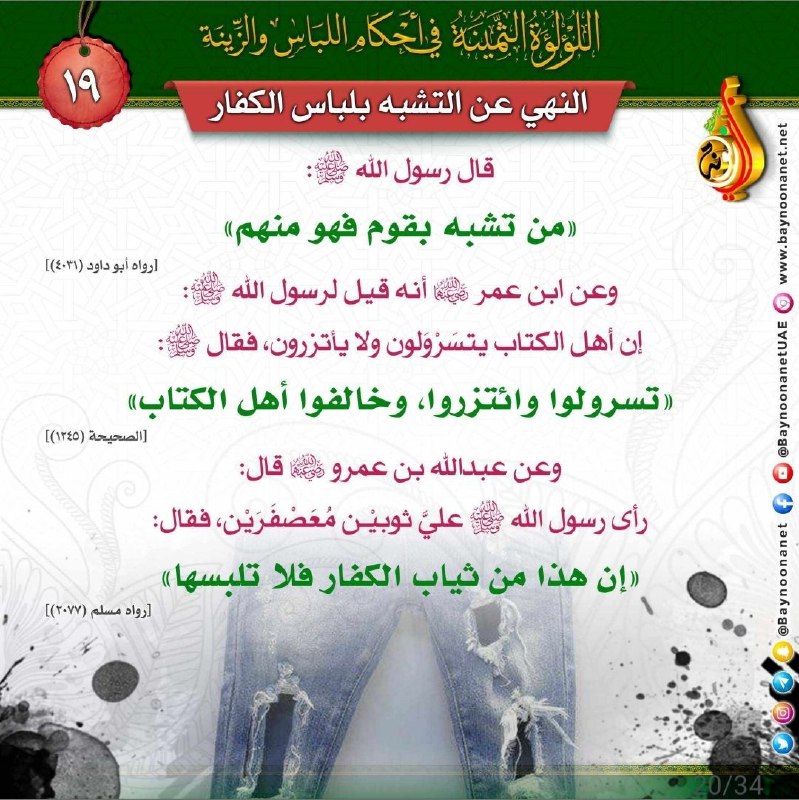
19: The prohibition of imitating the clothing of the disbelievers
The Messenger of Allāh ﷺ said:
“Whoever imitates a people is one of them.”
[Reported by Abū Dāwūd (4031)]
And from Ibn ʿUmar that it was said to the Messenger of Allāh ﷺ: “The People of the Book wear trousers and do not wear waist-wrappers.”
So he said:
“Wear trousers, and wear waist-wrappers, and differ from the People of the Book.”
[Al-Ṣaḥīḥah…
The Precious Pearl concerning the rulings of clothing and adornment
18: Women imitating men, and vice versa
It is narrated from Abū Hurayrah that he said:
“The Messenger of Allāh ﷺ cursed the man who wears the clothing of women, and the woman who wears the clothing of men.”
[Reported by Abū Dāwūd (4098)]
And from Ibn ʿAbbās:
that the Prophet ﷺ cursed women who imitate men, and men who imitate women.
[Ṣaḥīḥ Abū Dāwūd (4097)]
The Precious Pearl concerning the rulings of clothing and adornment
17: Covering the ’Awrah (private parts) and not exposing it
The Messenger of Allāh ﷺ said:
“Guard your private parts except from your wife or those whom your right hand possesses.”
It was said: “What if people are together with one another?”
He said:
“If you are able that no one sees it, then let no one see it.”
[Reported by Abū Dāwūd (4017)]
Explanation: His statement, “when people are together with one…
The Precious Pearl concerning the rulings of clothing and adornment
16: Tattooing
It is narrated from ʿAbdullāh ibn Masʿūd that he said:
“The Messenger of Allāh ﷺ cursed the women who tattoo and those who seek to be tattooed.”
[Reported by Al-Bukhārī (5931) and Muslim (2125)]
Explanation: Al-Washm (tattooing) is piercing the skin with a needle and filling it with ink or kohl.
Just as tattooing is not permissible, it is also not permissible to wound or scar the skin in order to…
The Precious Pearl concerning the rulings of clothing and adornment
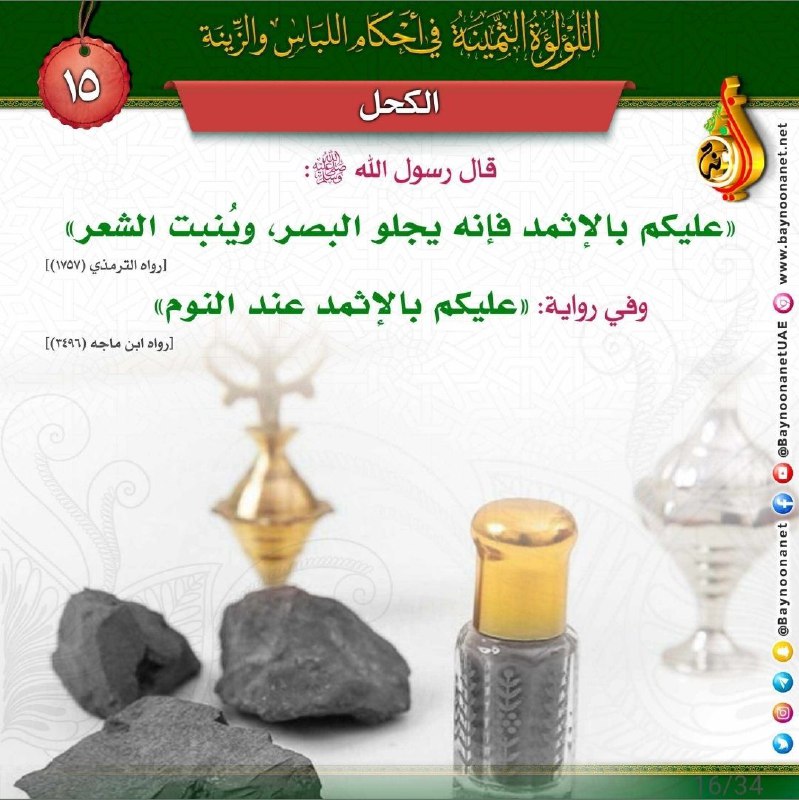
15: Kohl (eyeliner)
The Messenger of Allāh ﷺ said:
“Use ithmid, for it clears the eyesight and causes the hair to grow.”
[Reported by At-Tirmidhī (1757)]
In another narration:
“Use ithmid at the time of sleeping.”
[Reported by Ibn Mājah (3496)]
The Precious Pearl concerning rulings on clothing and adornment
14: Necklaces worn on the neck by women and children
It is narrated from ʿĀʾishah that she borrowed a necklace from Asmāʾ,
and it was lost. The Messenger of Allāh ﷺ sent a man, and he found it.
[Reported by al-Bukhārī (336) and Muslim (367)]
And from Abū Hurayrah that the Prophet ﷺ instructed him to call Al-Ḥasan ibn ʿAlī. So Al-Ḥasan ibn ʿAlī came walking, and around his neck was As-Sikhāb.
[Reported by…
The Precious Pearl in the Rulings of Dress and Adornment
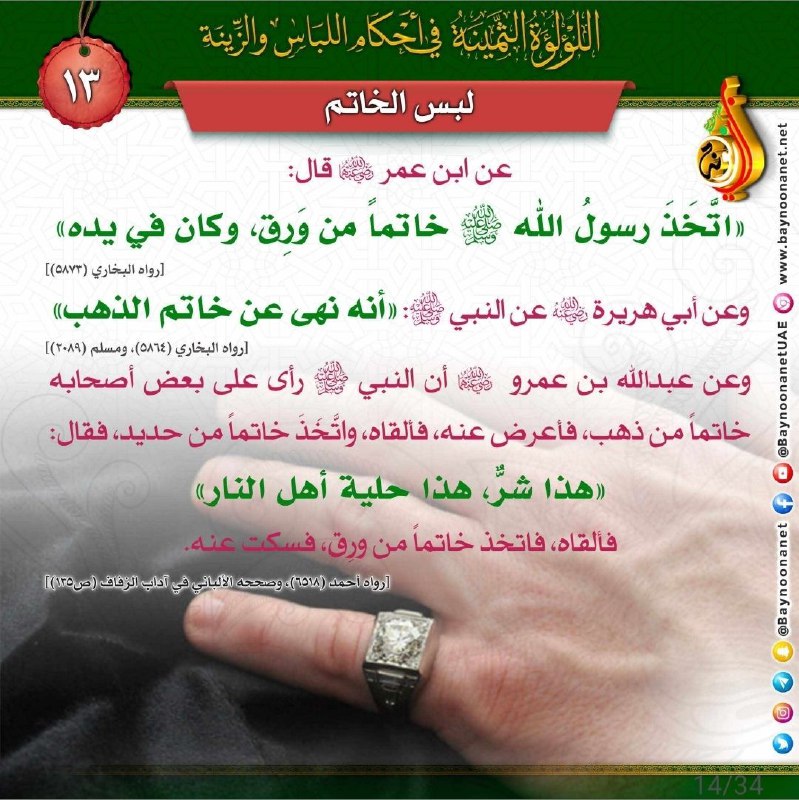
13: Wearing Rings
Narrated from Ibn ʿUmar:
The Messenger of Allāh ﷺ wore a ring made of silver.
[Reported by Al-Bukhārī 5873]
It is also narrated from Abū Hurayrah
that the Prophet ﷺ forbade wearing gold rings.
[Reported by Al-Bukhārī 5864, Muslim 2089]
Narrated from ʿAbdullah ibn ʿAmr: The Prophet ﷺ saw one of his companions wearing a gold ring. He turned away from him, so the man removed it. He then wore a…
The Precious Pearl in the Rulings of Dress and Adornment
12: Fragrance for Men and Women
The Prophet ﷺ said:
“I was made fond of two things from the worldly life: women and perfume.”
[Ṣaḥīḥ An-Nasā’ī 3939]
It was narrated from Abū Saʿīd Al-Khudrī that the Prophet ﷺ was asked about musk, and he said:
“It is the best of your perfumes.”
[Ṣaḥīḥ Abī Dāwūd 992]
He ﷺ also said:
“The perfume of a man is that its scent is apparent while its colour is hidden, and the perfume of…
The Precious Pearl in the Rulings of Dress and Adornment
11: Using the Miswak (Tooth-stick)
The Prophet ﷺ said:
“Were it not that it would be difficult for my nation, I would have ordered them to use the miswak with every prayer.”
In another narration:
“With every wudu (ablution).”
[Reported by Al-Bukhārī 887, Muslim 252, Ṣaḥīḥ Al-Jāmiʿ 5317]
He also said:
“The miswak cleanses the mouth and pleases the Lord.”
[Ṣaḥīḥ An-Nasā’ī 5]
The Precious Pearl in the Rulings of Dress and Adornment
10: Natural Acts (Sunan Al-Fiṭrah)
The Prophet ﷺ said:
“Five practices are part of the natural disposition (Al-fiṭrah): circumcision, removing pubic hair (Al-istihdād), trimming the mustache, clipping the nails, and plucking the underarm hair.”
[Reported by Al-Bukhārī 5891, Muslim 257]
Explanation: Al-Fiṭrah refers to what humans are naturally inclined to consider good and beneficial, and what their nature is…