Telegram Channel · Masjid As-Sahabah

Manhaj Benefits

1998
Posts
80
Pages
August 2023
Oldest Post
Join @almanhajussalafi on Telegram
Showing 25 of 1998 posts · page 11 of 80
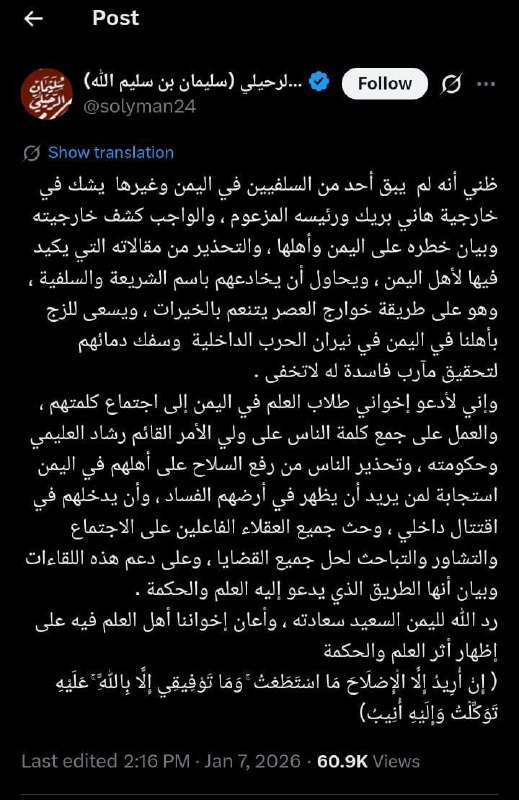
From Khurooj Against The Scholars to Khurooj Against The Ruler - Hani ibn Buraik

From Khurooj Against The Scholars to Khurooj Against The Ruler - Hani ibn Buraik

Part 1 - Before Fully Going Astray The manhaj of the Kitab and the Sunnah, and the manhaj of the Salaf As-ṣāliḥ calls for unity and togetherness with every Muslim. It does not call for siding with a Yemeni who lives in the north while creating regionalism merely because injustice and corruption exist. The people of the south themselves were the callers to unity. We all learned this in schools from a young age—we…
Continue reading View on Telegram
Respect the scholars and give them their due right | Abu Aisha Majid Al-Afghani

Respect the scholars and give them their due right | Abu Aisha Majid Al-Afghani

Open post page View on Telegram

BENEFIT 526: Whoever slanders ʿĀʾishah (may Allāh be pleased with her) with that which Allah Himself declared her innocent is a disbeliever and is not excused on the basis of ignorance

Qāḍī Abū Yaʿlā Al-Ḥanbalī said, as cited in Aṣ-Ṣārim Al-Maslūl (pp. 565–566): “Whoever slanders ʿĀʾishah with that from which Allāh has absolved her has disbelieved, without any difference of opinion. More than one scholar has transmitted consensus on this, and more than one of the leading imams has explicitly stated this ruling.” End quote. Imām An-Nawawī (may Allāh have mercy on him) said in Sharḥ Ṣaḥīḥ Muslim…
Continue reading View on Telegram

BENEFIT 525: There's no عذر بالجهل when it comes to insulting Allāh, His Prophets and His Religion

Imām Ibn Bāz (may Allāh have mercy on him) said, as recorded in Majmūʿ Fatāwā (vol., pp. 75–77): “Whoever insults Allāh, Glorified and Exalted be He, in any manner whatsoever; or insults the Messenger Muḥammad ﷺ, or any of the other messengers, in any manner whatsoever; or insults Islam; or belittles or mocks Allāh or His Messenger ﷺ—then he is a disbeliever and an apostate from Islam, even if he claims to be a…
Continue reading View on Telegram

BENEFIT 524: What is the proper criterion for العذر بالجهل (excusing someone on the basis of ignorance)?

Sheikh Najeeb Ash-Shar’abi ḥafidhahullāh said: One who lacks Tawḥīd due to ignorance is not called a Muslim; rather, he is a mushrik (polytheist). Some scholars have transmitted a consensus on this point. However, his wealth and blood are not deemed lawful until the proof has been established against him. This is the meaning of excusing him on the basis of ignorance. This applies in worldly matters. As for the…
Continue reading View on Telegram

BENEFIT 523: What is the condition of Saʿeed Al-Kammali?

Answered by Sheikh Najeeb Ash-Sharʿabi ḥafidhahullāh [4th of Muḥarram, 1444 AH] Who is he? - A Moroccan doctor and professor who holds a doctorate in Fiqh. - He is famous in Morocco and internationally. Main Points of Criticism 1. He is heavily inclined toward tamadh-hub (particularly the Mālikī madhhab) and dismisses those who call to taking directly from the dalīl (evidence). If tamadh-hub leads to blind…
Continue reading View on Telegram

𝗠𝗮𝗱𝗿𝗮𝘀𝗮𝘁𝘂𝗻𝗮 𝗕𝗲𝗻𝗲𝗳𝗶𝘁𝘀 (25)

The Practice of Head Shaving Question: Is shaving the entire head with a razor, such that no hair remains, outside of ḥajj and ʿumrah considered an imitation of the Khawārij? And should one object to a person who does this? Shaykh Najeeb Ash-Shar’abi ḥafidhahullāh: Shaving the head is a prescribed act of worship that is obligatory in ḥajj and ʿumrah, by explicit textual evidence and scholarly consensus. It is…
Continue reading View on Telegram
Supplementary fatwas & benefits regarding charity organisations

Supplementary fatwas & benefits regarding charity organisations

Decisive ruling on charity organisations https://t.me/almanhajussalafi/1422?single The innocence of Salafiyyah from charity organisations https://t.me/almanhajussalafi/1424 Ten points of reflection for members of charity organisations https://t.me/almanhajussalafi/1375 Sheikh Albani's stance on charity organisations https://t.me/almanhajussalafi/1403 Sheikh Muqbil's stance on charity organisations…
Continue reading View on Telegram

I noticed that the above speech of Shaykh Rabee’ is being misused to solicit public donations, particularly by those planning to invite a high-ranking member of Ihyaa’ At-Turath.

Shaykh Rabee’ has passed away and can no longer speak for himself, rahimahullah, but those familiar with his methodology will confirm that his approach is different from the one being promoted by these individuals. Cautioning Salafees from following the ways of the ikhwanees and hizbees Part 1 ⤵️ https://t.me/madrasatuna/2754 Part 2 ⤵️ https://t.me/madrasatuna/2758 Part 3 ⤵️ https://t.me/madrasatuna/2768 Part 4…
Continue reading View on Telegram

هل يجوز عمل صندوق خيري لمساعدة الناس | الشيخ العثيمين رحمه الله

Open post page View on Telegram

DOUBT: Salafis do not allow any organisational work or cooperation

Shaykk Rabee’ ibn Hadi al-Madkhali, may Allāh have mercy upon him, said: "Organisation is sometimes necessary in Islam—organising finances and organisation in aspects of da’wah. There is nothing wrong with this in-shā-Allāh. For instance, I may create a schedule for a group of my brothers: “You, so-and-so, will give a lecture at such-and-such masjid; you, so-and-so, will teach a lesson, and so on...” Organising…
Continue reading View on Telegram

BENEFIT 521: Why does an author place his name at the beginning of a book?

The eminent scholar Al-Biqāʿī (may Allāh have mercy on him) said: As for the author, he is the one who composes the book, placing his name upon it so that his standing may be known and confidence placed in it. Indeed, the purified Sunnah has established this practice in the Prophet’s—peace and blessings be upon him—sending of letters, wherein he introduced himself by saying: “From Muhammad.” Since the purpose was…
Continue reading View on Telegram

BENEFIT 520: The meaning of Ḍimāmāh’s statement: “I shall neither add to this nor subtract from it.”

Abūl-ʿAbbās Al-Qurṭubī said, as cited in Al-Mufhim (1/159): It has been said that its meaning is: I shall not alter the prescribed obligations mentioned, neither by adding to them nor by reducing them. It is not valid to say that its meaning is: I shall not perform anything in addition to these mentioned obligations, whether from the supererogatory acts or from other obligations, should they later be prescribed,…
Continue reading View on Telegram

BENEFIT 519: An innovator is not to be trusted when refuting another innovator

Marwān ibn Muḥammad At-Ṭāṭarī said: “Three are not to be trusted: (1) the Ṣūfī, (2) the storyteller, and (3) an innovator who refutes another innovators.” This statement was reported from him by Qāḍī ʿIyāḍ in Tartīb Al-Madārik.
Open post page View on Telegram

BENEFIT 518: He only moved from one corner of the fire to another

A Magian who embraced Islam and later became a Rafidhi Imam Ibn Al-Jawzī said in Al-Muntadham (Vol. 4, p. 377) in the biography of Mihyār ibn Marzawayh, Abul-Ḥasan Al-Kātib Al-Fārisī: «كان مجوسياً فأسلم سنة أربع وتسعين وثلثمائة وصار رافضياً غالياً، وفي شعره لطف إلا أنه يذكر الصحابة بما لا يصلح» “He was a Magian, then embraced Islam in the year 394 AH, and became an extreme Rafidhi. His poetry contains elegance,…
Continue reading View on Telegram
The Precious Pearl in the Rulings of Dress and Adornment

The Precious Pearl in the Rulings of Dress and Adornment

1. Al-Qaza‘ (Partial Head Shaving) https://t.me/Menzbenefits/173 2. Hair Extension (Attaching Hair) https://t.me/Menzbenefits/174 3. Combing and Styling the Hair https://t.me/Menzbenefits/175 4. The Virtue of Gray Hair and the Ruling on Changing It Without Using Black https://t.me/Menzbenefits/176 5. Covering the Head and Not Uncovering It https://t.me/Menzbenefits/177 6. Letting the Beard…
Continue reading View on Telegram

IMPORTANT NOTE

Sheikh Sulayman Ar-Ruhaili ḥafidhahullāh notes: Some people, whenever they meet someone, say “I love you for the sake of Allah” without knowing any reason that warrants such love for Allāh’s sake. This is incorrect. Love for Allāh and for His sake is a love that resides genuinely in the heart, based on a valid cause—such as the person’s uprightness, adherence to the Sunnah or their defense of it. When true love…
Continue reading View on Telegram

CLOSE THE DOOR ALTOGETHER!

One must be cautious of saying “I love you for the sake of Allah” to the opposite gender. They should not be deceived by the thought that it is harmless love for Allāh's sake, or that the woman is far away, older, or unrelated. Many have been misled by such ideas, resulting in harm to both their religion and worldly life. People can become attached to someone of the opposite gender whom they have never seen, until…
Continue reading View on Telegram

PRACTICAL EXAMPLE

A woman sent a question to Shaykh ʿAbdul-ʿAzīz ibn Bāz rahimahullah through the programme “Nūr ʿalā Ad-Darb,” saying: “Allāh knows how much I love you for the sake of Allāh. I ask you, our Shaykh, to give me advice sincerely for the sake of Allāh, just as you would advise one of your daughters regarding my religion and my character. I hope for this.” The Shaykh replied: “May Allāh love you for whose sake you love…
Continue reading View on Telegram

BENEFIT 517: Loving the Opposite Gender for the Sake of Allāh and Expressing That

Question: Is it permissible for a woman to say about unrelated (non-maḥram) men—such as scholars and righteous people—that she loves them for the sake of Allāh? Sheikh Salih Al-Fawzan hafidahullah: Yes. Loving for the sake of Allāh and loyalty for the sake of Allāh are among the greatest bonds of faith. As stated in the ḥadīth: “Loving for the sake of Allāh and hating for the sake of Allāh are the strongest bonds…
Continue reading View on Telegram

BENEFIT:

Imām Adh-Dhahabī said in his biography of Al-Ḥāfidh Abū Al-Faḍl As-Sulāmī, the shaykh of Ibn Al-Jawzī: «ومن جرّح وعدّل لم يسمَّ في عرف أهل الحديث أنه يتكلم في أعراض الناس، بل قال ما يجب عليه» “One who engages in Jarh wa Ta'deel is not, according to the custom of the scholars of ḥadīth, considered to be speaking ill of people’s honour; rather, he has spoken only what is incumbent upon him.” [Tārīkh Al-Islām,…
Continue reading View on Telegram

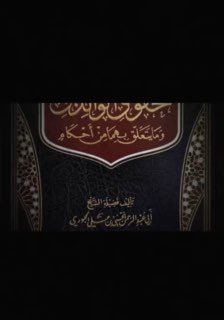
صيحة إنذار بالقطع للكافر المعين إذا مات على كفره المتيقن بالنار

تأليف الشيخ المجاهد : أبي حاتم سعيد بن دعاس المشوشي اليافعي رحمه الله وتقبله في الشهداء تقديم : الشيخ المحدث أبي عبد الرحمن يحيى بن علي الحجوري حفظه الله
Open post page View on Telegram

BENEFIT 517: Is One Who Dies as a Disbeliever Judged to be in Hell?

Questioner: Is a person who dies as a disbeliever to be judged as destined for the Fire in a specific and definite sense? Sheikh Yahya Al-Hajoori ḥafidhahullāh: Whoever dies while disbelieving in Allāh, having departed from the fold of Islam, is judged to be destined for the Fire, just as Allāh and His Messenger have ruled concerning him. This was the path followed by the early generations, may Allāh be pleased…
Continue reading View on Telegram

BENEFIT 516: Suicide Missions

Question: Is it allowed for someone to blow themselves up, claiming it is to be a form of jihad? They use as evidence the saying of Allāh: "Indeed, Allāh has purchased from the believers their lives and their properties in exchange for Paradise..." (9:111). They also use the story of the boy and the king and the story of a Companion of the Prophet (whom the questioner cannot recall). They also ask: Is it permissible…
Continue reading View on Telegram

BENEFIT 515: Not Every Suspicion Is a Sin

Sheikh Ibn ʿUthaymeen, may Allāh have mercy on him, said: “Not every suspicion (dhann) is sinful. Suspicion based on strong indications, approaching certainty, is permissible. However, suspicion that arises merely from imagination or conjecture is not allowed. For example, if a man sees another man with a woman, and the man is known for his integrity and justice, it is not permissible for him to accuse that man of…
Continue reading View on Telegram
No posts match your search.

Try a different keyword or clear the search.