Did you know you can overdose on a spice used in desserts? The spice is nutmeg and it's a poor man's substitute for recreational drugs - it's actually categorized as a psychoactive drug by the U.S. Food and Drug Administration (FDA).
The spice comes from the seed of an evergreen tree, Myristica fragrans, indigenous to the eastern islands of the Moluccas but now widely cultivated. Arab traders brought nutmeg to…
Should Requesting Washing Water from One Suspected of Evil Eye Lead to Enmity?
Question: If I request the ghusl water from the one who gave me the evil eye, could this cause enmity between us?
Answer: Enmity only arises from such a request if the person is ignorant and unaware of the prophetic guidance regarding this matter. The Messenger of Allāh ﷺ said:
((وإذا استغسلتم فاغسلوا))
“If you are asked to wash (for…
Speaker | Sheikh Abu Atiyah
Topics:
-> Importance of brotherhood
-> The blessing of Salafiyyah and importance of calling to it
-> Staying away from sins; for indeed, blessings are removed due to sins [Ibn Qayyim]
-> Do not remain silent upon good advice
-> Don't be like the hizbis!
Part 1 https://quickshare.samsungcloud.com/6AVQXf6wf7rj
Part 2 https://quickshare.samsungcloud.com/nXqVKmVcn67v
Guidance and Encouragement In Treating Long-Term Spiritual Affliction
Question: Peace, mercy, and blessings of Allāh be upon you. Please help me — may Allāh bless you. After more than 20 years, I have come to know this year that I am afflicted by a black revenge spell given to me in a sweet I ate. It destroyed my self-confidence, and unfortunately, I cannot complete my work. I live with doubts and delusions, I hold…
The scholars who said it is not allowed to take a wage argued that: These acts (teaching Qur'ān, Ḥadīth, Fiqh, leading prayer, giving adhān) are acts of worship that must be done by a Muslim. A disbel
Those who allow payment said:
This is a benefit received by the student, so it is allowed to take money for it, like any other useful service.
The middle view, which is stronger, is that: If the teacher is in need, and he uses this to support his family, he can do the teaching for Allāh and still take money to help him continue. Earning a living for one’s family is also a religious obligation. So he combines both…
Question: What is the ruling on giving lessons in exchange for a set amount of money, which is required by the organisers before the lessons begin? This amount is also shown in the advertisements for these lessons.
Sheikh Najeeb Ash-Shar’abi ḥafidhahullāh:
Giving lessons in exchange for a set amount of money required by the organisers before the lessons begin, and showing this amount in advertisements, is…
BENEFIT 477: A very important principle that every student of knowledge should be aware of
Sheikh Albani raḥimahullāh states:
"...I must mention a very important principle that every student of knowledge should be aware of in order to gain proper understanding of religion. That principle is: general textual evidences in the Sunnah should be implemented in the same manner in which they were applied during the time of the Prophet ﷺ. It is not appropriate to extract a new meaning from a hadith that was not…
BENEFIT 476: Ruling on Giving Large Sums of Money to Disbelievers
His Eminence Shaykh Ṣāliḥ al-Fawzān (may Allāh preserve him) was asked:
What is the ruling on donating large sums of money to disbelievers?
Answer:
If this is done for the benefit of the Muslims, then there is no objection — it may be done to ward off their harm. Even zakāh, as you've come across in Kitab Az-Zakāh, may be given to those whose hearts are inclined to Islam, as well as disbelievers from whom harm is…
BENEFIT 475: Is Obedience Required if a Woman Assumes Leadership?
Sheikh Sulayman Ar-Ruhaili hafidahullah mentioned:
"Although this issue is, in reality, one of the contemporary occurrences (nawāzil), I will address the relevant legal (Shar‘i) implications. The question posed is: What is the correct stance if a woman is appointed as a leader over a village, a region, or even a higher position?
I will not discuss the ruling of female leadership per se, but rather focus on a…
وعليكم السلام ورحمة الله وبركاته
If he preaches Tawheed and Sunnah, one has the option to remain or leave. But if he preaches Hizbiyyah, then one should not remain.
BENEFIT 474: Should You Remain to Listen to the ’Eid Khutbah If the Imam Is an Innovator?
Question:
السلام عليكم ورحمة الله وبركاته
الله يحفظكم
I wanted to ask, if my nearby masjid is a known spubs affiliated masjid, should I stay or leave for the khutbah after the ’Eid Salah? Whilst I do have the ability to travel to Masjid Muqbil instead, this masjid is alot closer for my family and I to attend
جزاكم الله خيرا
Sheikh Yūsuf Al-Jazaa’iri hafidahullāh:
وعليكم السلام ورحمة الله وبركاته
Eid prayer is…
BENEFIT 473: A Salafi Remains a Salafi — Even at Work!
Question: I am a brother who loves the Salafi da‘wah, and I am currently working in a supermarket in the Kingdom of Saudi Arabia. However, the store sells cigarettes. My employer recently asked me to work at the computer, although I have been working in the store for over four years as a regular worker. I stipulated to him that I would not directly sell cigarettes. If a customer requests cigarettes, I either call…
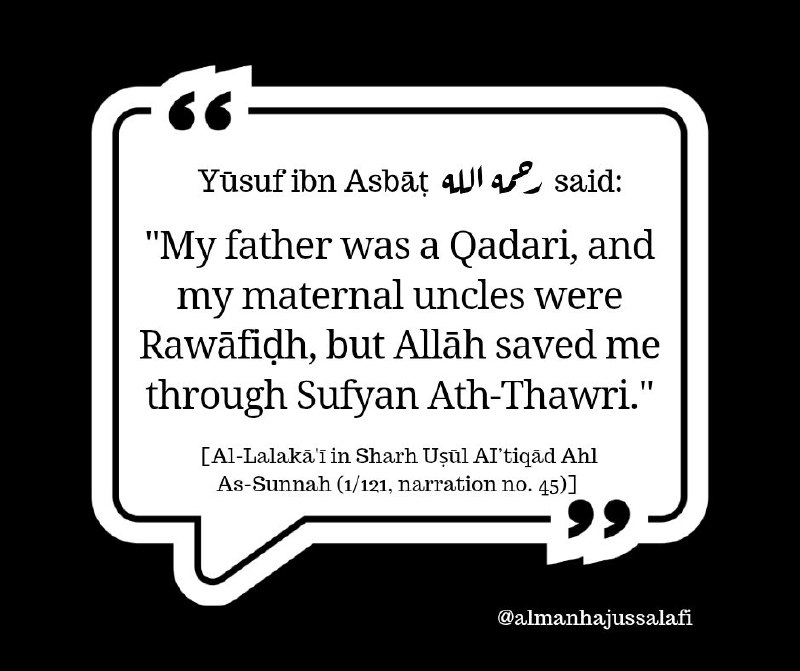
Among The Signs of Allāh’s Favour Upon a Student of Knowledge is Granting Him the Company of Ahlus-Sunnah
قال يوسف بن أسباط رحمه الله: «كان أبي قدريًّا، وأخوالي روافضَ، فأنقذني اللهُ بسفيان الثوري»
[أخرجه اللالكائي في الاعتقاد ١٢١/١ أثر ٤٥]
#Salafi_quotes #Beneficial_quotes
BENEFIT 472: A Sign of Foolishness: Rejecting an Opponent's Argument Before It's Heard
A benefit taken from Abu Atiyyah's lecture regarding Ṣulḥ Ḥudaybiyyah:
"...He (Budail) said: 'if you want I can relay this information to you.'
فَقَالَ «سُفَهَاؤهم لَا حَاجَة لَنَا أَن تُخْبِرَنَا عَنْهُ بِشِي»
The fools from among them said: "We don't need to hear anything that you have to say about him."
وَقَالَ ذَوُو الرَأِي مِنْهُمْ
And those who were wise among them said:
«هَاتِ مَا سَمْعت»
"Let us hear…
Where's so-and-so? We don't see them anymore?
Common response:
It's none of my business. I haven't been appointed to watch over them!
Advice of a scholar:
‎Sheikh Muḥammad ibn Ṣāliḥ Al-ʿUthaymīn raḥimahullāh said: “It is not from the brotherhood of īmān that when you see your brother falling short in the rights (of the religion) or you find him indulging in prohibited affairs you forsake him, making him a prey…
How can this be equated with someone who knew the falsehood, defended it knowingly, refuted those who opposed it, allied with its advocates, and attacked the people of truth with the most severe and r
Whoever attempts to judge both categories of people with the same standard is pursuing injustice. Is this not like someone trying to weigh camels and gold using the same scale?
In truth, those who are guilty of applying double standards are the adherents of the new Hizbi movement—such as Al-Buraʿī, Adh-Dhamārī, As-Sālimī, and Aṣ-Ṣawmalī, among others—for they judged Abul-Ḥasan, Al-Maghrāwī, and ʿArʿūr with a…


![Al-Hāfidh Ibn Ḥajar rahimahullah said: "Displaying happiness on ’Eid is among the manifest symbols of the religion." [Fat-ḥ Al-Bārī (2/443)]](https://cdn4.telesco.pe/file/EQAnb6KYOznGMcE3WW-ybxeqSReZKmlZne2E8i4zFy9Wzlg-f5h8g_ESsMbXB7scNlPAp-q5F_LFKmcY-pTCzKePDeU6-QnG_g95uDWaJ_fSXqqOzb6ni1_c1bEmENnFjVpwAk-vl6-aWk_RMaX4EVykJLyVfcJmWGALj6sgYlHPFBwix6bXVIx8O2KbXEfInTpgRvC_Tj5Xv5nxOyFnlxcmGIvJZUUeL6uicDXMRcx1W7rW2CYPgakNmNLKoIc8pQHJgBNpmXvvZOKz899vPOdNY3Wq9RfS3mLEz4ibw5H0ytRSR5uCF1geKVOtQ-5dd1hF2c3WoSk4dyR_WvhthA.jpg)